
Limescale-Related Boiler Problems in Tonbridge: When Is Emergency Repair the Right Call?
Limescale is a familiar problem in areas where hard water is present. It can gradually build up inside components that heat or move water, potentially affecting how efficiently a boiler operates. While some scale-related symptoms develop slowly, others can appear alongside faults that need prompt attention.

Why you can trust our content
We understand that the boiler industry can be confusing, with plenty of outdated or misleading information. That’s why we rely only on trusted, proven sources to guide our advice and installations:






At a glance
For homeowners, the difficult part is knowing whether an unusual boiler noise, loss of hot water or pressure problem can wait for a routine appointment or requires urgent professional assessment. Understanding the warning signs can help you respond appropriately without assuming that every boiler problem is caused by limescale.
If your boiler is behaving differently from normal, professional diagnosis is more useful than trying to identify the fault from the symptom alone. Scale may be involved, but components, controls, circulation, pressure and other parts of the heating system can also cause similar problems.
What Does Limescale Have to Do With Boiler Problems?
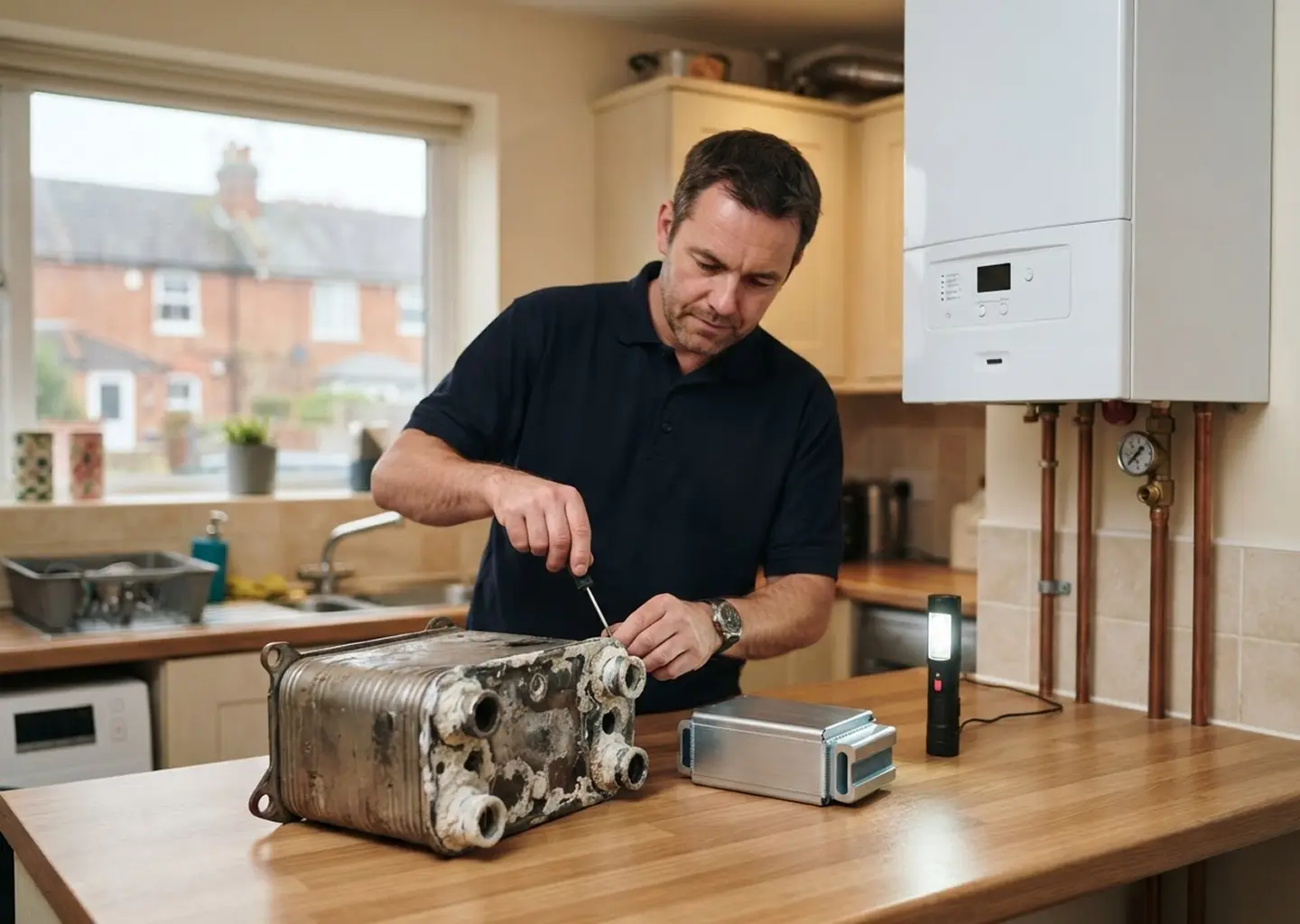
Limescale is a mineral deposit that can form when hard water is heated. Over time, deposits may accumulate on components that come into contact with heated water, particularly within parts of the hot water system.
The effect depends on the boiler design, water conditions, system condition and extent of scale accumulation. A small amount of scale does not automatically mean that a boiler has suffered serious damage.
However, significant deposits can contribute to problems such as:
- Reduced heat transfer
- Longer hot water heating times
- Unusual kettling or humming noises
- Reduced hot water performance
- Increased strain on certain components
- Repeated faults in some circumstances
These symptoms are not exclusive to limescale. That is why a qualified engineer should diagnose the underlying cause before deciding what work is necessary.
Why Can Scale Cause Noisy Boiler Operation?
One commonly discussed symptom of scale accumulation is a kettling-type noise. This can happen when water flow and heat transfer are affected around a heat exchanger.
The sound may resemble a kettle boiling or produce rumbling, popping or whistling noises. However, unusual sounds can have several causes, including circulation problems, trapped air, pressure issues or component faults.
A noisy boiler should therefore not automatically be treated with a descaling solution. The correct response depends on what the engineer finds during assessment.
Which Boiler Symptoms Should Never Be Ignored?
Not every boiler fault represents an emergency. Nevertheless, certain symptoms should be treated seriously because they can indicate a safety issue or a significant system fault.
Homeowners should seek professional advice promptly if they notice:
- A suspected gas leak
- A carbon monoxide alarm activating
- A boiler repeatedly shutting down
- Water leaking from or around the boiler
- Burning smells or unusual electrical smells
- Significant loss of heating or hot water
- Repeated pressure problems
- Unusual noises accompanied by other faults
If you suspect a gas leak or carbon monoxide issue, follow the relevant emergency safety guidance rather than continuing to operate the appliance.
Limescale should not distract from these warning signs. A boiler problem may have several contributing factors, and safety should always take priority over identifying whether scale is involved.
If your boiler has developed an unusual symptom, arrange professional advice so the underlying cause can be identified before deciding whether repair, servicing or replacement is needed.
When Is Boiler Repair More Appropriate Than Waiting for a Service?
Routine servicing and fault repair have different purposes. A service is generally planned maintenance intended to check the appliance and help identify developing issues. A repair is needed when a known or suspected fault requires attention.
If your boiler suddenly stops providing heating or hot water, repeatedly locks out or develops a serious leak, waiting for the next scheduled service may not be appropriate.
For homeowners searching for boiler repair Tonbridge, the important consideration is not simply whether limescale is present. The engineer needs to establish what is actually causing the problem.
A repair assessment may consider:
- The boiler’s age and condition
- The specific fault symptoms
- Whether scale is affecting relevant components
- Availability and condition of replacement parts
- Previous repair history
- Whether the boiler remains suitable for the property
- The likely cost and extent of necessary work
This approach helps avoid replacing an otherwise serviceable boiler simply because it has developed one scale-related issue.
Could Limescale Turn a Minor Boiler Problem Into a Bigger One?
Potentially, but it depends on the circumstances.
A boiler that is already operating inefficiently may continue to experience strain if an underlying problem is ignored. If scale is contributing to restricted heat transfer or poor hot water performance, continued operation may not resolve the issue.
However, it is important not to assume that every untreated boiler fault will inevitably become a major failure. Some problems remain relatively limited, while others worsen quickly.
The best indicator is the condition of the appliance and the nature of the fault identified during professional assessment.
Signs That a Boiler Needs Attention Soon
|
Symptom |
Possible concern |
Appropriate response |
|
Rumbling or kettling noise |
Scale or circulation issue |
Arrange professional assessment |
|
Hot water takes longer to heat |
Heat transfer or component issue |
Have the system checked |
|
Boiler repeatedly locks out |
Fault or safety-related issue |
Seek professional advice |
|
Water leaking |
Component or system fault |
Prompt professional attention |
|
Pressure repeatedly drops |
Leak or pressure-related problem |
Arrange diagnosis |
|
No heating or hot water |
Boiler or control fault |
Consider prompt repair assessment |
The table is a guide rather than a diagnosis. Similar symptoms can have very different causes.
When Should You Consider Emergency Boiler Repair in Tonbridge?
The term emergency repair should be reserved for situations where a boiler problem requires prompt attention rather than simply being inconvenient.
For example, a complete loss of heating during cold weather may be particularly disruptive, especially for households with vulnerable occupants. A significant water leak, suspected gas problem or carbon monoxide concern can also require immediate action.
If you are searching for emergency boiler repair tonbridge, focus first on the actual symptom and its potential safety implications rather than assuming that limescale is responsible.
There is a useful distinction between:
- Urgent safety problems: These should be dealt with promptly and according to appropriate emergency guidance.
- Major operational failures: A complete loss of heating or hot water may warrant an urgent repair appointment.
- Persistent performance problems: These may require timely investigation but are not necessarily emergencies.
- Minor symptoms: Occasional noises or gradual performance changes may be suitable for a planned inspection, depending on the circumstances.
When in doubt, professional advice can help determine the appropriate response.
Can Limescale Affect a New Boiler Installation?
Limescale does not necessarily prevent a new boiler from being installed. However, water quality and system conditions are relevant considerations when selecting and installing heating equipment.
During boiler installation Tonbridge, an installer may need to consider the existing heating system, pipework, water conditions, system cleanliness and the requirements of the proposed appliance.
Scale protection may also be worth discussing where hard water is a known concern.
Potential considerations include:
- Whether the existing system needs cleaning
- The condition of the heating pipework
- Hot water requirements
- Water pressure and flow
- The type and configuration of the new boiler
- Appropriate scale management measures
- Manufacturer installation requirements
The aim is not to add unnecessary equipment or treatment. It is to understand the property’s conditions and determine what is appropriate for the new system.
Does an Old Boiler With Limescale Always Need Replacing?
No. Limescale alone does not provide enough information to determine whether replacement is necessary.
A relatively modern boiler with one repairable scale-related issue may still have useful service life remaining. Conversely, an older appliance with repeated faults, declining reliability and expensive or difficult-to-source components may make replacement worth considering.
The decision should therefore look at the complete picture.
Questions to Consider Before Replacing the Boiler
- How old is the boiler?
- Has it required multiple repairs recently?
- Is the fault directly related to scale?
- Are replacement parts available?
- How well does the boiler meet the property’s heating and hot water needs?
- Would repairing it provide reasonable continued service?
- Are there efficiency or reliability reasons to consider a new system?
A professional assessment can help separate a manageable repair from a wider end-of-life problem.
If repeated faults are becoming a pattern, ask for an assessment that considers both the immediate repair and the longer-term condition of the appliance.
How Can Homeowners Reduce Scale-Related Boiler Problems?
There is no single solution that guarantees a boiler will never experience scale-related problems. However, sensible maintenance can help identify developing issues and keep the wider heating system in good condition.
Useful steps include:
Arrange Appropriate Servicing
Regular servicing can help identify developing appliance issues before they become more disruptive. The appropriate servicing interval should follow the manufacturer’s instructions and the circumstances of the appliance.
A service is also an opportunity to discuss recurring symptoms such as unusual noises, inconsistent hot water or repeated pressure changes.
Pay Attention to Changes in Performance
Small changes can provide useful clues. If hot water becomes noticeably slower, the boiler starts making unfamiliar noises or the system behaves differently, do not simply assume that the change is normal.
Early investigation may provide more options than waiting until the boiler stops working completely.
Consider Scale Management
Where hard water is an established concern, homeowners can discuss suitable scale management options with a qualified professional.
The correct approach depends on the property, water conditions, boiler type and manufacturer’s requirements. Avoid choosing treatment equipment based solely on general advice because systems and installation requirements vary.
What If the Boiler Is Already Showing Scale-Related Symptoms?
Start with the symptom rather than the presumed cause.
For example, if the boiler is making a new rumbling noise, an engineer should investigate the cause. If the boiler has lost pressure, the reason for the pressure loss needs to be established. If hot water performance has deteriorated, several components could be involved.
A proper diagnosis helps determine whether the appropriate response is:
- Repair
- Servicing
- Cleaning or system treatment
- Component replacement
- Monitoring
- Full boiler replacement
This is particularly important where a boiler has been installed for many years. Spending money on repeated repairs without considering the appliance’s overall condition may not be the most practical long-term approach.
A Typical Tonbridge Boiler Scenario
Imagine a homeowner notices that their boiler has gradually become noisier when producing hot water. At first, the noise is occasional, so they continue using the system.
Several weeks later, hot water takes longer to heat and the boiler begins shutting down intermittently.
It would be tempting to conclude that limescale is responsible for everything. However, the correct approach is to have the appliance assessed. The engineer may find scale, but they may also identify a component fault, circulation issue or another underlying problem.
If the appliance is otherwise in good condition, repair may be appropriate. If several faults are present and the boiler is approaching the end of its useful life, replacement may need to be discussed.
This example shows why symptoms should be investigated rather than treated as a diagnosis.
Limescale can contribute to boiler performance problems in hard water conditions, but it should not automatically be blamed for every fault. Unusual noises, slower hot water production, repeated shutdowns and pressure changes can have several possible causes.
The key is to distinguish between a minor developing symptom, a repairable boiler fault and a situation requiring urgent attention. Safety concerns such as suspected gas leaks, carbon monoxide alarms and significant leaks should always take priority.
For a new system, discussing water conditions and scale management during boiler installation Tonbridge can help ensure relevant factors are considered from the outset. For an existing appliance, professional diagnosis can establish whether repair is appropriate or whether replacement should be considered.
If your boiler is behaving differently from normal, getting the problem assessed early can help you understand the options and make a more informed decision about the next step.
Need help with a boiler problem? A professional assessment can establish what is causing the symptoms and whether repair, servicing or installation advice is appropriate.
Related articles

At a glance
For homeowners, the difficult part is knowing whether an unusual boiler noise, loss of hot water or pressure problem can wait for a routine appointment or requires urgent professional assessment. Understanding the warning signs can help you respond appropriately without assuming that every boiler problem is caused by limescale.
If your boiler is behaving differently from normal, professional diagnosis is more useful than trying to identify the fault from the symptom alone. Scale may be involved, but components, controls, circulation, pressure and other parts of the heating system can also cause similar problems.
What Does Limescale Have to Do With Boiler Problems?
Limescale is a mineral deposit that can form when hard water is heated. Over time, deposits may accumulate on components that come into contact with heated water, particularly within parts of the hot water system.
The effect depends on the boiler design, water conditions, system condition and extent of scale accumulation. A small amount of scale does not automatically mean that a boiler has suffered serious damage.
However, significant deposits can contribute to problems such as:
- Reduced heat transfer
- Longer hot water heating times
- Unusual kettling or humming noises
- Reduced hot water performance
- Increased strain on certain components
- Repeated faults in some circumstances
These symptoms are not exclusive to limescale. That is why a qualified engineer should diagnose the underlying cause before deciding what work is necessary.
Why Can Scale Cause Noisy Boiler Operation?
One commonly discussed symptom of scale accumulation is a kettling-type noise. This can happen when water flow and heat transfer are affected around a heat exchanger.
The sound may resemble a kettle boiling or produce rumbling, popping or whistling noises. However, unusual sounds can have several causes, including circulation problems, trapped air, pressure issues or component faults.
A noisy boiler should therefore not automatically be treated with a descaling solution. The correct response depends on what the engineer finds during assessment.
Which Boiler Symptoms Should Never Be Ignored?
Not every boiler fault represents an emergency. Nevertheless, certain symptoms should be treated seriously because they can indicate a safety issue or a significant system fault.
Homeowners should seek professional advice promptly if they notice:
- A suspected gas leak
- A carbon monoxide alarm activating
- A boiler repeatedly shutting down
- Water leaking from or around the boiler
- Burning smells or unusual electrical smells
- Significant loss of heating or hot water
- Repeated pressure problems
- Unusual noises accompanied by other faults
If you suspect a gas leak or carbon monoxide issue, follow the relevant emergency safety guidance rather than continuing to operate the appliance.
Limescale should not distract from these warning signs. A boiler problem may have several contributing factors, and safety should always take priority over identifying whether scale is involved.
If your boiler has developed an unusual symptom, arrange professional advice so the underlying cause can be identified before deciding whether repair, servicing or replacement is needed.
When Is Boiler Repair More Appropriate Than Waiting for a Service?
Routine servicing and fault repair have different purposes. A service is generally planned maintenance intended to check the appliance and help identify developing issues. A repair is needed when a known or suspected fault requires attention.
If your boiler suddenly stops providing heating or hot water, repeatedly locks out or develops a serious leak, waiting for the next scheduled service may not be appropriate.
For homeowners searching for boiler repair Tonbridge, the important consideration is not simply whether limescale is present. The engineer needs to establish what is actually causing the problem.
A repair assessment may consider:
- The boiler’s age and condition
- The specific fault symptoms
- Whether scale is affecting relevant components
- Availability and condition of replacement parts
- Previous repair history
- Whether the boiler remains suitable for the property
- The likely cost and extent of necessary work
This approach helps avoid replacing an otherwise serviceable boiler simply because it has developed one scale-related issue.
Could Limescale Turn a Minor Boiler Problem Into a Bigger One?
Potentially, but it depends on the circumstances.
A boiler that is already operating inefficiently may continue to experience strain if an underlying problem is ignored. If scale is contributing to restricted heat transfer or poor hot water performance, continued operation may not resolve the issue.
However, it is important not to assume that every untreated boiler fault will inevitably become a major failure. Some problems remain relatively limited, while others worsen quickly.
The best indicator is the condition of the appliance and the nature of the fault identified during professional assessment.
Signs That a Boiler Needs Attention Soon
|
Symptom |
Possible concern |
Appropriate response |
|
Rumbling or kettling noise |
Scale or circulation issue |
Arrange professional assessment |
|
Hot water takes longer to heat |
Heat transfer or component issue |
Have the system checked |
|
Boiler repeatedly locks out |
Fault or safety-related issue |
Seek professional advice |
|
Water leaking |
Component or system fault |
Prompt professional attention |
|
Pressure repeatedly drops |
Leak or pressure-related problem |
Arrange diagnosis |
|
No heating or hot water |
Boiler or control fault |
Consider prompt repair assessment |
The table is a guide rather than a diagnosis. Similar symptoms can have very different causes.
When Should You Consider Emergency Boiler Repair in Tonbridge?
The term emergency repair should be reserved for situations where a boiler problem requires prompt attention rather than simply being inconvenient.
For example, a complete loss of heating during cold weather may be particularly disruptive, especially for households with vulnerable occupants. A significant water leak, suspected gas problem or carbon monoxide concern can also require immediate action.
If you are searching for emergency boiler repair tonbridge, focus first on the actual symptom and its potential safety implications rather than assuming that limescale is responsible.
There is a useful distinction between:
- Urgent safety problems: These should be dealt with promptly and according to appropriate emergency guidance.
- Major operational failures: A complete loss of heating or hot water may warrant an urgent repair appointment.
- Persistent performance problems: These may require timely investigation but are not necessarily emergencies.
- Minor symptoms: Occasional noises or gradual performance changes may be suitable for a planned inspection, depending on the circumstances.
When in doubt, professional advice can help determine the appropriate response.
Can Limescale Affect a New Boiler Installation?
Limescale does not necessarily prevent a new boiler from being installed. However, water quality and system conditions are relevant considerations when selecting and installing heating equipment.
During boiler installation Tonbridge, an installer may need to consider the existing heating system, pipework, water conditions, system cleanliness and the requirements of the proposed appliance.
Scale protection may also be worth discussing where hard water is a known concern.
Potential considerations include:
- Whether the existing system needs cleaning
- The condition of the heating pipework
- Hot water requirements
- Water pressure and flow
- The type and configuration of the new boiler
- Appropriate scale management measures
- Manufacturer installation requirements
The aim is not to add unnecessary equipment or treatment. It is to understand the property’s conditions and determine what is appropriate for the new system.
Does an Old Boiler With Limescale Always Need Replacing?
No. Limescale alone does not provide enough information to determine whether replacement is necessary.
A relatively modern boiler with one repairable scale-related issue may still have useful service life remaining. Conversely, an older appliance with repeated faults, declining reliability and expensive or difficult-to-source components may make replacement worth considering.
The decision should therefore look at the complete picture.
Questions to Consider Before Replacing the Boiler
- How old is the boiler?
- Has it required multiple repairs recently?
- Is the fault directly related to scale?
- Are replacement parts available?
- How well does the boiler meet the property’s heating and hot water needs?
- Would repairing it provide reasonable continued service?
- Are there efficiency or reliability reasons to consider a new system?
A professional assessment can help separate a manageable repair from a wider end-of-life problem.
If repeated faults are becoming a pattern, ask for an assessment that considers both the immediate repair and the longer-term condition of the appliance.
How Can Homeowners Reduce Scale-Related Boiler Problems?
There is no single solution that guarantees a boiler will never experience scale-related problems. However, sensible maintenance can help identify developing issues and keep the wider heating system in good condition.
Useful steps include:
Arrange Appropriate Servicing
Regular servicing can help identify developing appliance issues before they become more disruptive. The appropriate servicing interval should follow the manufacturer’s instructions and the circumstances of the appliance.
A service is also an opportunity to discuss recurring symptoms such as unusual noises, inconsistent hot water or repeated pressure changes.
Pay Attention to Changes in Performance
Small changes can provide useful clues. If hot water becomes noticeably slower, the boiler starts making unfamiliar noises or the system behaves differently, do not simply assume that the change is normal.
Early investigation may provide more options than waiting until the boiler stops working completely.
Consider Scale Management
Where hard water is an established concern, homeowners can discuss suitable scale management options with a qualified professional.
The correct approach depends on the property, water conditions, boiler type and manufacturer’s requirements. Avoid choosing treatment equipment based solely on general advice because systems and installation requirements vary.
What If the Boiler Is Already Showing Scale-Related Symptoms?
Start with the symptom rather than the presumed cause.
For example, if the boiler is making a new rumbling noise, an engineer should investigate the cause. If the boiler has lost pressure, the reason for the pressure loss needs to be established. If hot water performance has deteriorated, several components could be involved.
A proper diagnosis helps determine whether the appropriate response is:
- Repair
- Servicing
- Cleaning or system treatment
- Component replacement
- Monitoring
- Full boiler replacement
This is particularly important where a boiler has been installed for many years. Spending money on repeated repairs without considering the appliance’s overall condition may not be the most practical long-term approach.
A Typical Tonbridge Boiler Scenario
Imagine a homeowner notices that their boiler has gradually become noisier when producing hot water. At first, the noise is occasional, so they continue using the system.
Several weeks later, hot water takes longer to heat and the boiler begins shutting down intermittently.
It would be tempting to conclude that limescale is responsible for everything. However, the correct approach is to have the appliance assessed. The engineer may find scale, but they may also identify a component fault, circulation issue or another underlying problem.
If the appliance is otherwise in good condition, repair may be appropriate. If several faults are present and the boiler is approaching the end of its useful life, replacement may need to be discussed.
This example shows why symptoms should be investigated rather than treated as a diagnosis.
Limescale can contribute to boiler performance problems in hard water conditions, but it should not automatically be blamed for every fault. Unusual noises, slower hot water production, repeated shutdowns and pressure changes can have several possible causes.
The key is to distinguish between a minor developing symptom, a repairable boiler fault and a situation requiring urgent attention. Safety concerns such as suspected gas leaks, carbon monoxide alarms and significant leaks should always take priority.
For a new system, discussing water conditions and scale management during boiler installation Tonbridge can help ensure relevant factors are considered from the outset. For an existing appliance, professional diagnosis can establish whether repair is appropriate or whether replacement should be considered.
If your boiler is behaving differently from normal, getting the problem assessed early can help you understand the options and make a more informed decision about the next step.
Need help with a boiler problem? A professional assessment can establish what is causing the symptoms and whether repair, servicing or installation advice is appropriate.